


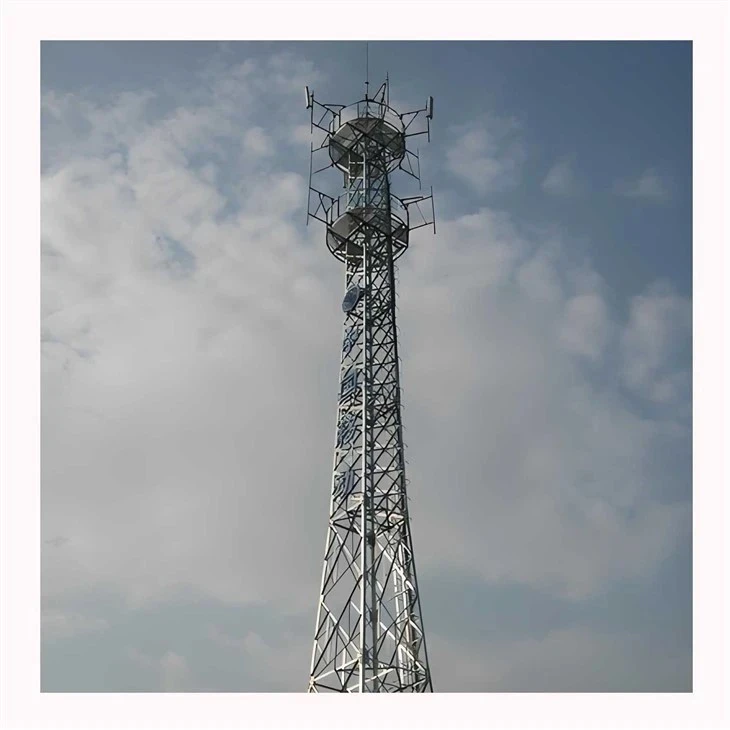
Transposition Tower
Product Overview
The Transposition Tower is used in high-voltage transmission lines to swap phase conductor positions and balance electrical parameters.The Transposition Tower is used in high-voltage transmission lines to swap phase conductor positions and balance electrical parameters.
Core Features
Cross-arm layout based on phase sequence enables controlled conductor transposition between line sections.
Independent suspension points maintain conductor geometry and ensure phase-to-phase clearance remains unchanged during transposition.
Overall structural stiffness under asymmetric conductor configuration is maintained by continuous angle steel lattice system.
86 μm hot-dip galvanized coating provides long-term corrosion protection in coastal, humid, and industrial environments.
Technical Specifications
|
Parameter |
Specification |
|
Material Grade |
Q355B, Q420B, Q460C, ASTM A572 GR50 / GR65 |
|
Corrosion Protection |
Hot-dip galvanizing (ASTM A123 / ISO 1461) |
|
Voltage Level |
110kV–1000kV |
|
Max Wind Speed |
30–65 m/s (project dependent) |
|
Design Standards |
ASCE 10-15, TIA-222-H, IEC 60826, EN 1993 |
|
Structural Analysis |
Finite element global and joint verification |
|
Welding Inspection |
100% UT and MT |
|
Fasteners |
Grade 8.8 / 10.9 high-strength bolts with double locking system |
Electrical & Structural Design Inputs
System voltage level and transposition scheme (120° cyclic rotation)
Conductor type, bundle configuration, and electrical clearance requirements
Span length, wind load, and ice loading conditions
Conductor swing envelope under maximum wind conditions
Terrain classification and seismic design criteria
Manufacturing & Quality Control
Segmental trial assembly is used to verify geometric accuracy and hole alignment prior to shipment
Manufactured under ISO 9001 system with welding procedures compliant with AWS D1.1 and EN 1090
Each shipment includes MTC, galvanizing thickness reports, UT/MT inspection reports, and trial assembly records
Packaging & Shipping
Members are nested by geometry type, protected with edge guards, and secured on export-grade pallets
Each component carries a unique stamped ID linked to drawings and assembly sequence
Transport protection includes internal bracing and restraint systems to control vibration and displacement during shipment
FAQ
Hot Tags: transposition tower, China transposition tower manufacturers, suppliers, factory, anchor tower conductor anchoring system, dead end tower modular structure system, double circuit suspension tower structure, heavy duty angle tower foundation system, heavy duty angle tower steel fabrication system, transmission line tower for power system blockchain management development
You Might Also Like


Send Inquiry